Cybersecurity Master Program Training in Hyderabad
Build cybersecurity skills across ethical hacking, SOC operations, penetration testing and cloud security in 5–6 months. Classroom and live online training include practical exercises, Virtual labs* and an academy-issued certificate.

Course
Cybersecurity Master Program
Training Mode
Classroom & Online
Level
Beginner to Advanced
Practical Learning
Hands-on Training
Best Cyber Security Master Training in Hyderabad With Placement Support
Are you searching for the best cybersecurity training institute in Hyderabad that offers comprehensive placement support? Look no further than Nexson IT Academy, located in the heart of Ameerpet, Hyderabad – the IT training hub of India. Our Cyber Security Master Program is designed to transform beginners into industry-ready cybersecurity professionals within 5-6 months.
At Nexson IT Academy, we understand that cybersecurity is one of the fastest-growing career fields in India and globally. With cyber threats increasing exponentially, organizations across Hyderabad, KPHB, Madhapur, Hitech City, and throughout India are actively seeking skilled cybersecurity professionals. Our cybersecurity master program in Hyderabad bridges the gap between academic knowledge and industry requirements.
Industry-Aligned Curriculum
Our curriculum is developed in consultation with industry experts and updated regularly to include the latest cybersecurity trends, tools, and techniques.
100% Placement Assistance
We provide comprehensive placement support including resume building, mock interviews, soft skills training, and direct connections with 100+ hiring partners.
What sets our cybersecurity placement institute in KPHB and Ameerpet apart is our commitment to practical, hands-on learning. Every concept taught in our classroom is reinforced with real-world labs, simulations, and projects. Students gain experience with enterprise-grade security tools, SIEM platforms, and ethical hacking environments that mirror actual industry setups.
🎯 Key Highlights of Our Cybersecurity Master Training:
- 6–7 month intensive program
- 100+ modules across 5 courses
- Real-world attack & defense labs
- Nexson IT Academy Master Certificate
- Weekend & weekday batch options
- Classroom + Online hybrid mode
- Personal laptop lab setup
- Direct placement with IT companies
Cyber Security Master Online Course in India (Live Instructor-Led Training)
Can't attend our Ameerpet classroom? No problem! Nexson IT Academy offers the same comprehensive Cyber Security Master Online Course in India through our live instructor-led training platform. Our online cybersecurity training provides the same quality education with the flexibility to learn from anywhere in India or internationally.
Our cybersecurity online instructor-led training is not pre-recorded content. You'll interact with our expert trainers in real-time, participate in live hacking demonstrations, collaborate with fellow students, and get your doubts cleared instantly. This ensures you receive the same immersive learning experience as our classroom students in Hyderabad.
Live Classes
Real-time interaction with instructors and peers via Zoom/Google Meet
Cloud Labs
Virtual labs* also provided; confirm access details
Doubt Sessions
Dedicated Q&A sessions and WhatsApp support group
Students from across India – including Bangalore, Chennai, Mumbai, Delhi, Pune, and international locations – have successfully completed our online cybersecurity master program. Our online platform includes screen sharing for live demonstrations, breakout rooms for group exercises, and recorded sessions for revision.

📌 Online Training Features:
Top Features of Cybersecurity Master Certification Course
Our Cybersecurity Master Certification Course at Nexson IT Academy is carefully designed to provide you with every skill, tool, and certification you need to launch a successful cybersecurity career. Here's what makes our program stand out from other cybersecurity training institutes in Hyderabad:
Comprehensive 5-Month Curriculum
Cover everything from basics to advanced topics including ethical hacking, SOC operations, cloud security, and security leadership.
Nexson IT Academy Certificate
On successful completion you receive the Nexson IT Academy Cybersecurity Master Program Certificate — recognized by our hiring partners. No third-party vendor certifications are included or promised.
Extensive Hands-On Labs
Practice in real enterprise environments with Kali Linux, Metasploit, Splunk, AWS Security Hub, and other professional tools.
Expert Industry Trainers
Learn from certified industry professionals with 10+ years of real-world experience in cybersecurity.
100% Placement Assistance
Dedicated placement cell with 100+ hiring partners, resume building, mock interviews, and job referrals.
Flexible Learning Modes
Choose classroom training in Ameerpet, live online classes, or hybrid mode as per your convenience.
Real-World Projects
Work on 5+ industry projects including vulnerability assessments, incident response, and security audits.
Virtual labs*
Virtual labs* are also provided alongside BYOD practical training. Confirm access conditions and covered tools with admissions.
Cyber Security Master Training Program Overview for Beginners & Professionals
Whether you're a complete beginner with no IT background or an experienced professional looking to specialize in cybersecurity, our Cyber Security Master Training Program is structured to accommodate all skill levels. The program follows a progressive learning approach, building from fundamentals to advanced concepts.
📋 Program Details at a Glance
| Program Name | Cyber Security Master Program |
| Duration | 6–7 Months |
| Mode | Classroom (Ameerpet) / Online Live / Hybrid |
| Eligibility | Graduates, Working Professionals, Career Changers |
| Prerequisites | Basic Computer Knowledge (No coding required) |
| Certificate | Nexson IT Academy Cybersecurity Master Certificate |
| Placement | 100% Placement Assistance |
| Fee | ₹1,00,000 (Flat pricing) |
Our program is ideal for students looking to start their career in cybersecurity, job seekers wanting high-paying tech jobs, career switchers from non-IT backgrounds, IT professionals looking to upskill, and working professionals seeking weekend batches for flexible learning.
2,500+
Students Trained
95%+
Placement Rate
8-15 LPA
Average Package
100+
Hiring Partners
Cybersecurity Master Program: Complete Curriculum
Course 01 — Ethical Hacking (1 Month • 30 Modules)
- Module 1 — Introduction to Ethical Hacking: What is ethical hacking and why it matters; White Hat / Black Hat / Grey Hat hackers; phases (Recon → Scanning → Exploitation → Post-Exploitation → Reporting); legal & ethical boundaries (written permission, scope, NDA); career paths (Pentester, Bug Bounty Hunter, SOC Analyst); CEH / OSCP / Security+ overview
- Module 2 — Linux Basics for Ethical Hackers: Hacking-focused Linux distros; installing Kali on VirtualBox/VMware; essential commands (ls, cd, pwd, cat, grep, find, chmod, sudo); managing services with systemctl; apt update / install; first bash automation script
- Module 3 — Anonymization & Privacy Techniques: Why anonymity matters; MAC address spoofing; fake identities & sandboxed environments; routing through multiple proxies; checking real IP vs masked IP
- Module 4 — Proxies and VPN: What a proxy server does; HTTP, SOCKS4, SOCKS5 differences; setting up proxy chains with free proxies; VPN vs proxy; combining VPN + proxy chains for layered anonymity
- Module 5 — Browsing Deep Web & Dark Web using Tor: Surface vs Deep vs Dark Web; how Tor onion routing works; installing & configuring Tor Browser; accessing .onion sites safely; risks (malware, scams, law enforcement)
- Module 6 — Information Gathering (OSINT): What is OSINT; passive vs active recon; Google Dorking (site:, inurl:, filetype:); WHOIS lookup; gathering emails / subdomains / IPs; finding internet-connected devices via search engines
- Module 7 — Network Scanning, Port Scanning & DNS Enumeration: Why scanning is the first active step; scan types (Ping, SYN, Version, OS detection, Aggressive); common ports (21, 22, 80, 443, 3389); DNS enumeration & subdomains; zone transfer attack; local network host discovery
- Module 8 — Password Cracking: Hash types (MD5, SHA1, bcrypt, NTLM); attack types (Dictionary, Brute Force, Rainbow Table, Mask); GPU-based cracking; cracking /etc/shadow and Windows NTLM; online password spraying (SSH, FTP, HTTP)
- Module 9 — Vulnerability Identification: Vulnerability vs exploit; CVE & CVSS scoring (Critical/High/Medium/Low); credentialed vs non-credentialed scans; web server vulnerability scanning; searching vuln databases from terminal
- Module 10 — Introduction to Exploitation Framework: Pentesting framework architecture (Exploits, Payloads, Auxiliaries, Post modules); core commands (search, use, info, set, run); singles vs stagers; bind vs reverse shells; in-memory shells; multi-platform payload generation
- Module 11 — Hacking Windows OS: Setting up vulnerable Windows VM; EternalBlue (MS17-010 / WannaCry); SMB exploitation; remote Meterpreter session; post-exploitation (sysinfo, getuid, ps, screenshot, hashdump); persistence after reboot
- Module 12 — Hacking Linux OS: Vulnerable Linux target setup; vsftpd 2.3.4 backdoor; Samba exploitation; getting & navigating a shell; reading /etc/passwd and /etc/shadow
- Module 13 — Privilege Escalation: Why attackers need privesc; Linux privesc (SUID binaries, sudo misconfigs, cron jobs, writable /etc/passwd); Windows privesc (unquoted service paths, DLL hijacking, token impersonation); automated enum tools; kernel exploits as last resort
- Module 14 — Creating Backdoors for Windows and Linux: How attackers maintain access; Windows EXE backdoors via payload generators; Linux ELF backdoors; encoding to evade basic AV; scheduled task / cron job persistence
- Module 15 — Sniffing: Passive network listening; ARP poisoning; packet capture & filtering; capturing HTTP credentials in cleartext; MITM tools and techniques
- Module 16 — Social Engineering: Hacking the human mind; Phishing, Spear Phishing, Vishing, Smishing, Baiting, Tailgating; phishing pages for credential harvesting; website cloning; email spoofing
- Module 17 — Denial of Service (DoS) Attack: DoS vs DDoS; Volumetric (UDP/ICMP), Protocol (SYN), Application (HTTP) floods; custom packet crafting; SYN flood simulation; mitigation (rate limiting, firewalls, CDN, scrubbing)
- Module 18 — Session Hijacking: Sessions and cookies; cookie theft via XSS; session fixation; capturing cookies from HTTP traffic; defenses (HttpOnly, Secure, short timeouts, HTTPS)
- Module 19 — Web Server Hacking & Web Page Defacement: Directory traversal & misconfigurations; banner grabbing; directory brute-forcing; defacement via vulnerable file upload
- Module 20 — Web Application Attacks: OWASP Top 10; XSS (Reflected, Stored, DOM); CSRF; IDOR; LFI / RFI; OS command injection
- Module 21 — SQL Injection: Why SQLi is still #1; manual SQLi (' OR '1'='1); Classic / Blind (Boolean / Time-based) / Out-of-Band SQLi; extracting databases, tables and columns; automated SQLi; parameterised queries & prepared statements as defense
- Module 22 — WiFi Hacking: WEP, WPA, WPA2, WPA3; monitor mode; capturing WPA2 4-way handshake; deauth attacks; WPA2 dictionary cracking; Evil Twin rogue AP
- Module 23 — Mobile Hacking: Android security model & APK structure; malicious APK creation; remote Android session; Android post-exploitation (camera, SMS, contacts, location); APK reverse engineering; iOS jailbreak overview
- Module 24 — IoT Hacking Techniques: Why IoT devices are easy targets; default credentials & unencrypted communication; finding IoT devices via search engines; firmware extraction & analysis; MQTT eavesdropping; Mirai botnet case study
- Module 25 — Cryptography Basics: Why crypto is the backbone of security; symmetric (AES, DES); asymmetric (RSA, ECC); hashing (MD5, SHA1, SHA256); digital signatures; SSL/TLS & HTTPS
- Module 26 — Steganography: Hiding data inside ordinary files; image steganography (JPEG/PNG); audio steganography (.wav / .mp3); hide & extract workflows; detection using hex editors
- Module 27 — Firewall Configuration: How firewalls filter traffic; packet filter, stateful, WAF, NGFW; Linux firewall chains (INPUT, OUTPUT, FORWARD; ACCEPT, DROP, REJECT); beginner-friendly wrappers; firewall evasion (fragmentation, tunnelling, allowed ports)
- Module 28 — Setting Up an Intrusion Detection System (IDS): IDS vs firewall; NIDS vs HIDS; installing open-source IDS on Linux; writing custom rules for port-scan detection; IDS vs IPS
- Module 29 — Honeypots: What is a honeypot; low/high-interaction, research, production types; deploying a low-interaction honeypot; analysing attacker behaviour from logs; honeytokens (fake files, accounts, URLs)
- Module 30 — Final Review, Practice Lab & Career Guidance: Full module recap; complete lab (scan → exploit → escalate → maintain access → cover tracks); online practice platforms; HackerOne / Bugcrowd / Intigriti onboarding; portfolio & report writing; Security+ → CEH → eJPT → OSCP roadmap
Course 02 — VAPT: Vulnerability Assessment & Penetration Testing (1.5 Months • 12 Modules)
- Module 1 — VAPT Fundamentals & Methodology: VA vs PT (classification vs active exploitation); Black / White / Grey Box; lifecycle (Planning → Recon → Scanning → Exploitation → Post-Exploitation → Reporting); Rules of Engagement (scope, IP ranges, time windows, emergency contacts); PTES, OSSTMM, NIST SP 800-115, ISSAF; CVSS v3.1 (Base, Temporal, Environmental); CVE / CWE / CPE databases (NVD, MITRE, Exploit-DB)
- Module 2 — Lab Setup & Essential Tools: Kali Linux on VirtualBox/VMware with adapter config; Metasploitable2, DVWA, VulnHub VMs with snapshots; Proxychains + VPN for anonymized testing; OSINT (Google Dorks, WHOIS, DNS, subdomain enumeration); email format & job posting fingerprinting; metadata extraction from PDF/DOCX/XLSX
- Module 3 — Network Scanning: Host discovery (ping sweep, treat-all-as-up, multiple probes); SYN, TCP, UDP, FIN, NULL, XMAS, ACK scans; service version, OS detection, Aggressive mode; NSE scripts (default, http-title, smb-vuln, ftp-anon, ssl-enum-ciphers); output formats (Normal, XML, Grepable, All); timing T0–T5 (stealth vs speed); evasion (fragmentation, decoys, source-port manipulation)
- Module 4 — Vulnerability Analysis: Credentialed vs non-credentialed scanning; policy creation & export; open-source full and limited scan configs; web server misconfig, outdated software, HTTP method testing; Nuclei template-based scanning (CVE, misconfig, exposure, takeover, fuzzing); manual CVE research (NVD, Exploit-DB, Vulners, PacketStorm, GitHub PoCs); validating false positives by manually reproducing every High/Critical finding
- Module 5 — Exploitation & Post-Exploitation: Metasploit architecture (exploits, payloads, auxiliaries, post modules, encoders); msfconsole workflow (search, use, info, options, set RHOSTS, run); staged vs stageless payloads; post-exploitation (sysinfo, getuid, getsystem, hashdump, ps, migrate, upload); pivoting (AutoRoute, SOCKS5); standalone payloads (EXE, DLL, APK, Python, PHP); EternalBlue, BlueKeep, Shellshock, Heartbleed; Windows credential dumping, Pass-the-Hash, Pass-the-Ticket; Linux SUID abuse, sudo misconfig, cron hijacking
- Module 6 — Web App Recon & Interception Proxy: Web fingerprinting (CMS, framework, server); directory enumeration with common wordlists; hidden GET/POST parameter discovery; JS file mining for API keys & endpoints; Burp proxy setup (intercept, modify headers/body, scope); Repeater for manual request crafting; Intruder modes (Sniper, Battering Ram, Pitchfork, Cluster Bomb); active vs passive scanner
- Module 7 — OWASP Top 10 Full Coverage: SQL Injection (error / union / blind / out-of-band) with tamper scripts for WAF bypass; OS command injection via shell metacharacters; LDAP / XPath / SSTI; XSS (Reflected, Stored, DOM); CSRF (token bypass, SameSite cookies); SSRF (internal port scan, cloud metadata); XXE (file read via external entity); file upload (extension bypass, MIME, magic bytes); broken authentication (session prediction, credential stuffing); IDOR (parameter tampering, UUID prediction, mass assignment); security misconfigurations (default creds, verbose errors, open dirs)
- Module 8 — Advanced Web Attacks: Vertical / horizontal authorization bypass; business-logic vulns (workflow abuse, race conditions); HTTP desync / request smuggling; DOM-based vulns (open redirect, DOM XSS, client-side template injection)
- Module 9 — API Penetration Testing: OWASP API Security Top 10 (2023); REST testing (auth bypass, BOLA/IDOR, mass assignment); GraphQL (introspection, query depth attacks, field suggestions); JWT manipulation; OAuth 2.0 flaws; fuzzing API parameters for hidden endpoints; rate-limiting bypass and API business-logic flaws
- Module 10 — Mobile VAPT: Android (APK extraction, decompilation, static analysis; insecure data storage; exported activities; content provider leaks; dynamic analysis; traffic interception; cert-pinning bypass); iOS (IPA extraction, plist inspection, keychain analysis; jailbreak detection bypass; runtime hooking); OWASP Mobile Top 10 (2023)
- Module 11 — Professional Report Writing: Executive Summary in non-technical language (business risk, severity, key findings); Scope & Methodology (IPs, dates, approach); per-finding documentation (Title, Risk, CVSS, Description, PoC, Impact, Fix); CVSS v3.1 score justification for every critical finding; Risk Matrix (Likelihood × Impact) for remediation roadmap; appendix (raw tool output, network diagram, methodology references)
- Module 12 — Capstone: Full VAPT Engagement: Simulated enterprise environment with multiple vulnerabilities; full-scope assessment (network + web + API + wireless); applying complete PTES end-to-end; pivoting to internal isolated systems; complete professional VAPT report; presentation of findings to a simulated client
Course 03 — Bug Bounty: Complete Hunting Program (1 Month • 10 Modules)
- Module 1 — Bug Bounty Ecosystem & Getting Started: HackerOne, Bugcrowd, Intigriti, Synack, YesWeHack — how the platforms work; public vs private programs (less competition, better scope, higher payouts); reading program policy (scope, out-of-scope, special rules, exclusions, safe harbor); severity ratings P1–P5; Hall of Fame programs (Google VRP, MSRC, Apple, Meta, Shopify); bug bounty vs pentesting (no fixed scope, time pressure, competition); target selection (large scope, new programs, technologies you know); learning from disclosed reports ($10K+ on HackerOne Hacktivity)
- Module 2 — Recon & Asset Discovery: Subdomain enumeration — passive (Subfinder, crt.sh), active brute-force, permutation; subdomain takeover detection (CNAME to deleted service); URL & endpoint discovery (historical URLs, crawling, JS file mining); hidden GET/POST parameter discovery; GitHub recon (secrets in public repos, commit history); tech stack & WAF fingerprinting; finding open S3 / Azure / GCP buckets
- Module 3 — XSS — Cross-Site Scripting: Reflected / Stored / DOM XSS hunting methodology; finding XSS by grepping all parameters and inspecting error messages and headers; WAF & filter bypass (case variation, HTML entities, SVG payloads); XSS in unusual sinks (PDF rendering, Markdown, SVG upload); blind XSS that fires when admin views logs / tickets; impact escalation to account takeover via session cookie theft
- Module 4 — SQL Injection & Injection Vulnerabilities: SQLi identification (error messages, boolean differences, time delays); union-based extraction (columns, database, tables, data); blind SQLi (Boolean and time-based); second-order SQLi (stored and triggered later); WAF bypass (comments, encoding, case variation, whitespace); command, LDAP and XPath injection; SSTI — template engine identification and RCE
- Module 5 — IDOR & Broken Access Control: IDOR identification across numeric IDs, UUIDs, emails, usernames in parameters; horizontal IDOR (other users at same privilege); vertical IDOR (higher-privilege functionality); BOLA in REST APIs (GET /api/users/{id} enumeration); mass assignment via extra JSON fields to elevate privileges; path traversal (../../etc/passwd) for arbitrary file read
- Module 6 — SSRF, XXE & Business Logic Bugs: SSRF — internal service enumeration & cloud metadata access (169.254.169.254); blind SSRF detection via Burp Collaborator (DNS / HTTP callbacks); SSRF bypass (localhost alternatives, IPv6, URL encoding); XXE (file read via external entity, SSRF via XXE, blind XXE); business logic (workflow bypass, price manipulation, discount abuse); race conditions (parallel coupon-application requests); 2FA bypass (code reuse, brute-force, response manipulation); password reset flaws (token prediction, host header injection)
- Module 7 — Advanced Techniques & API Hunting: OAuth 2.0 vulnerabilities (state CSRF, token leakage, open redirect); JWT attacks (none algorithm, weak secret brute-force, header injection); GraphQL (introspection enumeration, query depth attacks, batch query abuse); HTTP request smuggling (CL.TE and TE.CL desync); host header injection (password reset poisoning, cache poisoning); prototype pollution (__proto__ injection for XSS and RCE); web cache poisoning via unkeyed inputs
- Module 8 — Chaining Bugs for Maximum Impact: SSRF + Internal Service → RCE; XSS + CSRF → Account Takeover; Self-XSS + CSRF → Stored XSS upgrade; IDOR + Sensitive Data Exposure → full account takeover; Open Redirect + OAuth → token theft; combining low-severity bugs (P3s) into a single P1 chain; impact analysis to frame severity for maximum bounty payout
- Module 9 — Report Writing & Triage Communication: Bug report anatomy (Title, Severity, CVSS, Description, Steps to Reproduce, Impact, Fix); Proof of Concept (screenshots, HTTP request/response, curl); writing reproduction steps assuming the reviewer has zero prior context; impact framing (business risk, data exposure, unauthorized access); triage communication (responding to questions, providing additional evidence); handling duplicates and out-of-scope reports professionally; severity escalation when triagers underrate findings
- Module 10 — Automation, Tools & Building Your Profile: Automating the recon pipeline (subdomain → probe → screenshot → crawl → scan); custom wordlists from the target's application content; Nuclei custom templates for target-specific checks; portfolio building (publicly disclosed reports, GitHub CVE write-ups); building a hunter profile (HackerOne reputation, Bugcrowd points, Twitter presence); bug bounty income (taxes, invoicing, bank accounts for foreign payments); continuous learning (PortSwigger Web Academy, HackTricks, OffSec community)
Course 04 — SOC Analyst: Security Operations Center (2 Months • 21 Modules)
- Module 1 — SOC Fundamentals & Analyst Roles: SOC architecture (Tier 1 Alert Monitoring, Tier 2 Investigation, Tier 3 Threat Hunting); SOC models (In-house vs MSSP vs Hybrid); key metrics (MTTD, MTTR, False Positive Rate, Alert Volume); MITRE ATT&CK (14 Tactics, Techniques, Sub-Techniques, TTPs); Cyber Kill Chain — 7 phases with SOC detection points; Diamond Model of Intrusion Analysis; NIST CSF (Identify, Protect, Detect, Respond, Recover); alert triage (True/False Positive, severity, SLA); runbook vs playbook
- Module 2 — Linux CLI for SOC Analysts: File system navigation, file permissions, process management; user & group management; cron jobs as attacker persistence vector; key log files (/var/log/auth.log, syslog, kern.log, secure, messages); journalctl filtering (-u, -f, --since, --until); log parsing with grep / awk / sed / cut / sort / uniq; real-time log monitoring & suspicious-pattern identification; network CLI (ip addr, ss -tulnp, tcpdump, DNS troubleshooting)
- Module 3 — Lab Environment Setup: DetectionLab architecture (Windows DC, Workstation, Ubuntu Logger); pre-installed components (SIEM agent, IDS, network metadata, endpoint telemetry); Vagrant + VirtualBox / VMware deployment; system requirements (16GB+ RAM, 100GB+ disk); snapshots for safe rollback before attack simulations; running first attack simulation and observing alerts / correlated events; understanding the alert pipeline from endpoint to dashboard
- Module 4 — SIEM/XDR Platform Overview & Deployment (Wazuh): Core components (Manager, Indexer/OpenSearch, Dashboard, Agent); HIDS + FIM + Vulnerability Detection + CSPM + SCA in one platform; All-in-One vs Distributed deployment; Docker Compose deployment for lab; agent installation on Windows (MSI/PowerShell), Linux (DEB/RPM), macOS; agent groups & centralized configuration; agent enrollment (password-based vs certificate-based)
- Module 5 — Rules, Decoders & Detection Logic: Pre-decoding vs decoding pipeline; decoder XML syntax (parent, prematch, regex, order); custom decoders for proprietary log formats; rule XML structure (id, level, decoded_as, match, regex, frequency); rule levels 0–15 with severity & alert thresholds; custom rules for SSH brute force, RDP attacks, web attacks; tagging rules with MITRE ATT&CK technique IDs; FIM (real-time vs scheduled, who-data, ransomware detection); Active Response (built-in & custom scripts, brute-force IP blocking); vulnerability detection (CVE feeds, software inventory, CIS Benchmarks)
- Module 6 — Enterprise SIEM Setup & Log Sources (QRadar CE): Components (Console, Event Processor, Flow Processor, Data Node); CE limits (100 EPS, 5000 FPM — free for learning); installing on VM (24GB RAM, 250GB disk, 4 CPU); dashboard navigation (Offenses, Log Activity, Network Activity); log source management (Syslog, JDBC, SNMP, File, API); Device Support Modules (DSMs) — 400+ supported devices; LEEF & CEF format ingestion
- Module 7 — Enterprise SIEM Rules, Offenses & Correlation: AQL (Ariel Query Language) — SELECT, FROM events, WHERE, GROUP BY; rule types (Event, Flow, Common, Offense); Rule Wizard with test conditions; Building Blocks (BB) as reusable components; brute-force detection rule (5+ failures in 2 minutes); lateral movement detection rule; MITRE ATT&CK mapping for correlation rules; offense lifecycle (New → In Progress → Closed)
- Module 8 — SIEM Analytics & Search Processing Language (Splunk): Architecture (Indexer, Search Head, Forwarder, Deployment Server); Universal Forwarder install on Windows & Linux; data inputs (inputs.conf, HTTP Event Collector); SPL syntax (index=, sourcetype=, host=, time range); statistical commands (stats, count, avg, eval, rex); output formatting (table, fields, rename, sort); security SPL use cases (brute force, LSASS access, DNS exfiltration, lateral movement); dashboards with charts, tables, maps and scheduled alerts
- Module 9 — Network IDS/IPS (Suricata): IDS mode vs IPS mode (Inline / AF_PACKET); installing on Ubuntu with apt + auto-update for rule sets; configuration (interface, log paths, rule files); rule structure (action, proto, src/dst IP/port, options); rule options (msg, sid, content, pcre, flow, flags, threshold); custom rules for port scan, DNS exfiltration, malware C2; pulling ET Open & ET Pro rule sets; eve.json unified JSON log format (alert, dns, http, tls, flow); JA3 / JA3S TLS fingerprinting for malware C2 detection
- Module 10 — Network Protocol Metadata Analysis (Zeek): Network metadata vs signature detection (complementary); key log files (conn.log, dns.log, http.log, ssl.log, files.log); conn.log connection duration / bytes / state (SF, RSTO, S0); dns.log query / answer / TTL for DNS exfiltration detection; Zeek scripting (event handlers & hooks); detecting beaconing via periodic connection intervals; Intel Framework loading IoC lists (IPs, domains, hashes)
- Module 11 — Full Packet Capture & PCAP Analysis (Arkime): Architecture (Capture Process, Viewer, OpenSearch backend); configuration (interface, packet storage, retention); continuous PCAP to disk with session management & storage; web UI (session search, PCAP viewer, connections graph); search syntax (ip.src==, port.dst==, protocols==, tags==); pivoting from IDS/IPS alert to PCAP for deep investigation; reconstructing HTTP sessions & extracting files; decrypting TLS sessions using private keys
- Module 12 — Windows Deep Telemetry (Sysmon): Why deep telemetry fills Windows Event Log gaps; Sysmon configuration XML (include/exclude rules, modular framework); Event IDs 1 (Process Create), 3 (Network), 7 (Image Load), 8 (CreateRemoteThread), 10 (ProcessAccess), 11 (FileCreate), 12/13 (Registry), 22 (DNS); detecting Mimikatz via Event ID 10 (LSASS access); detecting PowerShell encoded commands (Event ID 1 + CommandLine); detecting lateral movement via Event ID 3 (SMB to remote host); detecting persistence via Event ID 12/13 (Run-key registry modification)
- Module 13 — Endpoint Visibility (Osquery): Osqueryd daemon vs interactive shell; installing Osquery on Windows, Linux & macOS; scheduled queries for continuous endpoint monitoring; detecting injected processes (SELECT FROM processes WHERE on_disk = 0); persistence detection (SELECT FROM startup_items); unusual ports (SELECT FROM listening_ports WHERE port NOT IN (80,443,22)); Fleet — centralized query & alert platform; threat hunting with Osquery across many endpoints
- Module 14 — Live DFIR & Endpoint Hunting (Velociraptor): Server + client architecture for live endpoint access; VQL (Velociraptor Query Language) basics & syntax; built-in artifacts (KapeFiles Targets, System Process List, Sys Users); collecting forensic artifacts (MFT, Prefetch, Event Logs, Browser History); running a hunt across all endpoints simultaneously; memory analysis via acquisition artifacts; detecting persistence (Windows.Persistence.* artifact collection); custom VQL notebook for incident investigation
- Module 15 — Threat Intelligence Platform (MISP): MISP architecture (Events, Attributes, Objects, Tags, Galaxies); installing MISP via Docker or script; taxonomies & tags including TLP (Traffic Light Protocol); galaxies (MITRE ATT&CK, Threat Actors, Ransomware Groups); enabling free MISP feeds (CIRCL, Abuse.ch, Botvrij.eu); attribute types (IP, Domain, URL, Hash, Email); exporting IoCs (STIX 2.1, OpenIOC, CSV, IDS rules, Network Intel); correlation engine auto-linking related indicators; integration with SOC tools via Python automation
- Module 16 — Threat Hunting Methodology: Reactive (IoC-based) vs proactive (hypothesis-based) hunting; MITRE ATT&CK as a hunting framework; Threat Hunting Loop (Hypothesis → Hunt → Discover → Improve Detections); hunting persistence (Startup Items, Scheduled Tasks, Registry Run Keys); credential access (LSASS access, SAM dump); lateral movement (Pass-the-Hash, PsExec, WMI Remote Execution); C2 beaconing (periodic connections, JA3 hash matching); intel-driven hunting (cross-referencing logs against threat feeds); documenting hunt findings & converting to detection rules
- Module 17 — Case Management Platform (TheHive + Cortex): Components (Cases, Tasks, Observables, Alerts, Timeline); installing TheHive + Cortex via Docker Compose; user roles (Admin, Analyst, Read-Only); creating cases (Title, Severity, TLP, PAP, Tags, Assignee); adding tasks (Triage, Analysis, Containment, Recovery); observables (IP, Domain, Hash, Email, URL) for evidence; case templates for common incident types; Cortex analyzers (VirusTotal, Shodan, AbuseIPDB); Cortex responders (block IP on firewall, isolate host); SIEM integration auto-creating cases via REST API
- Module 18 — SOAR & Playbook Automation (Shuffle): SOAR architecture (Workflows, Apps, Triggers, Execution History); installing SOAR platform via Docker Compose; drag-and-drop workflow builder; Playbook 1 (SIEM Alert → Auto-Enrich → Case Creation); Playbook 2 (New IoC → Update IDS Rules → Notify Slack); Playbook 3 (Brute Force Alert → Block IP via Active Response); Playbook 4 (Phishing Email → Extract IoCs → Threat Intel → Case); Playbook 5 (Offense → Case → Analyst Notification); error handling & retry logic; SOAR maturity model (Manual → Assisted → Automated)
- Module 19 — Incident Response Framework: NIST IR Lifecycle (Preparation, Detection, Containment, Eradication, Recovery, Post-Incident); IR Plan, Runbooks, Tool Readiness, Communication Tree; alert validation, scope assessment, severity classification; containment short-term (isolate) vs long-term (patch / rebuild); evidence chain-of-custody documentation; IR report writing (Executive Summary, Technical Findings, Remediation); metrics (Dwell Time, MTTD, MTTR, Systems Affected)
- Module 20 — Full SOC Simulation: Simulated APT attack (Initial Access → Persistence → Lateral Movement → Exfiltration); all tools active simultaneously during simulation; students rotate through L1 → L2 → L3 analyst roles; Detection Phase (SIEM alerts, IDS/IPS detection, endpoint telemetry); Investigation Phase (case creation, IoC analysis, PCAP reconstruction); Response Phase (automated playbooks, containment, evidence collection); Reporting Phase (complete IR report — Executive + Technical); Detection Coverage Map on ATT&CK Navigator
- Module 21 — SOC Career Readiness: Practice platforms (TryHackMe SOC L1 & L2, Hack The Box SOC Path, LetsDefend.io); building a SOC portfolio (lab screenshots, IR reports, dashboards); key skills to highlight (SIEM, MITRE ATT&CK, IR, Threat Hunting); common SOC interview questions & answers; GitHub portfolio (custom rules, scripts & playbooks); continuous learning (SANS Blue Team Summit, community forums, CTF competitions)
Course 05 — Cloud Security: AWS, Azure & GCP (1.5 Months • 16 Modules)
- Module 1 — Cloud Computing & Security Fundamentals: IaaS / PaaS / SaaS — security responsibilities per model; Shared Responsibility Model (AWS, Azure, GCP define boundaries differently); cloud risks (misconfiguration, exposed APIs, IAM over-privilege, insider threats); CSA Cloud Top Threats 2024 (misconfiguration, insecure interfaces, account hijacking); CSA CCM v4, CIS Benchmarks, NIST CSF 2.0, MITRE ATT&CK for Cloud
- Module 2 — Setting Up Free Tier Accounts (Zero Cost): AWS Free Tier (Always Free, 12-Month Free, billing alarms); enabling MFA on root account, creating IAM admin user; Azure Free Account ($200 credit + always-free services + Azure Student); Microsoft Defender for Cloud foundational CSPM tier (free forever); GCP Free Tier ($300 credit for 90 days + always-free services)
- Module 3 — IAM Deep Dive — AWS, Azure, GCP: Principle of Least Privilege; MFA factors; Federation (SAML 2.0, OAuth 2.0, OIDC); AWS IAM (Users → Groups → Roles → Policies, Permission Boundaries, SCPs); IAM Access Analyzer (external access, policy validation, unused permissions); Azure Entra ID (Security Defaults, RBAC, Conditional Access, PIM); GCP IAM (resource hierarchy, Roles, Service Accounts, IAM Recommender)
- Module 4 — AWS Network Security: VPC design (public / private / isolated subnets, route tables); Security Groups vs NACLs (stateful vs stateless); VPC Flow Logs (enabling, querying via CloudWatch & Athena); VPC Endpoints (Interface & Gateway types for private connectivity); AWS WAF (Web ACL rules, managed rule groups — free basic tier); AWS Shield Standard (free DDoS protection)
- Module 5 — AWS Threat Detection & Monitoring: AWS CloudTrail (API audit logging, multi-region trails — free 90-day); CloudWatch Logs (Log Groups, Metric Filters, Alarms — always-free tier); AWS Config (resource configuration history & rules — free evaluation); Amazon GuardDuty (threat intelligence + ML-based detection — 30-day free trial); GuardDuty findings (Recon, Crypto Mining, Credential Exfiltration); Amazon Inspector v2 (EC2 / ECR vulnerability scanning — 30-day free trial); AWS Security Hub (aggregated findings — 30-day free trial)
- Module 6 — AWS Data Security & Compliance: AWS KMS (CMKs, Key Policies, Key Rotation — free for 20 keys); S3 Block Public Access (account & bucket level); S3 Object Lock (WORM compliance — Governance vs Compliance Mode); AWS Config Conformance Packs (CIS, NIST, PCI-DSS — free evaluation); AWS Well-Architected Framework — Security Pillar (free review tool); AWS Trusted Advisor (free security checks)
- Module 7 — Azure Network Security: Virtual Networks (VNets), subnets, peering; Network Security Groups (NSGs) inbound / outbound rules (free); Azure Firewall (free trial — IDPS, TLS Inspection); Azure Bastion (secure RDP/SSH without public IPs); Azure DDoS Protection Basic (free for all Azure services); Azure Private Endpoint & Private Link for secure connectivity
- Module 8 — Microsoft Defender for Cloud & Sentinel: Defender for Cloud foundational CSPM (free forever); Secure Score for cloud security posture (free); Regulatory Compliance Dashboard (NIST, PCI-DSS, ISO 27001, CIS); Microsoft Sentinel (90-day free trial on Azure Monitor workspace); data connectors (Azure AD, M365, Syslog, CEF); KQL fundamentals (search, where, project, summarize, extend); detecting brute force, impossible travel, privilege escalation with KQL; automated playbooks via Logic Apps (free tier for IR automation)
- Module 9 — Azure Key Vault & Data Security: Azure Key Vault (Secrets, Keys, Certificates — free tier 10,000 ops/month); Soft Delete & Purge Protection for data recovery; Azure Storage encryption (SSE with Customer-Managed Keys); Shared Access Signatures (SAS) for secure token generation; Azure SQL (TDE, Dynamic Data Masking, Auditing — all free)
- Module 10 — GCP Security Services: VPC security (Firewall Rules, Hierarchical Firewall Policies — free); Cloud Armor (WAF & DDoS protection — free basic tier); Security Command Center Standard (free, includes Asset Inventory); Security Health Analytics (free misconfiguration detection); Cloud Audit Logs (Admin Activity, Data Access — free indefinitely); Cloud Logging (log-based metrics & alerting — free tier); GCP Secret Manager (6 active secrets free, 10,000 access ops free/month)
- Module 11 — Zero Trust Architecture & Open-Source CSPM: Zero Trust principles (Never Trust Always Verify, Micro-Segmentation); BeyondCorp Enterprise (Context-Aware Access — free trial); identity as the new perimeter; Prowler (open-source AWS/Azure/GCP security auditing — completely free); ScoutSuite (free multi-cloud auditing); CloudSploit (free open-source cloud security scanner); Trivy (free container & cloud config scanning); MITRE ATT&CK for Cloud (free at attack.mitre.org)
- Module 12 — DevSecOps & CI/CD Pipeline Security: Shift-Left Security with SDLC threat modeling (free STRIDE methodology); secrets detection in code (Gitleaks, TruffleHog); SAST (Semgrep CE, Bandit for Python, SonarQube CE); DAST (OWASP ZAP, Burp CE integration); SCA (OWASP Dependency-Check, Dependabot on GitHub); IaC security (tfsec, Checkov, Terrascan); Policy as Code (Open Policy Agent, SLSA framework); GitHub Actions security (secret scanning, Dependabot alerts)
- Module 13 — Container & Kubernetes Security: Docker security (Namespaces, cgroups, non-root user, minimal base images); Trivy (free Docker image scanning — CVEs, secrets, misconfigs); Docker Bench for Security (free CIS Docker Benchmark checker); Falco (free runtime threat detection — syscall rules for containers); Kubernetes RBAC (ClusterRoles, Roles, RoleBindings); Pod Security Admission (Restricted / Baseline / Privileged); Network Policies (ingress / egress traffic control per pod); Kube-bench (free CIS Kubernetes Benchmark checker); free managed K8s (EKS Free Tier, AKS free cluster management, GKE Autopilot)
- Module 14 — Cloud Penetration Testing: Misconfigured storage bucket exploitation (read/write exposure); SSRF to cloud metadata service for credential theft; IAM Privilege Escalation (41+ known escalation paths); open-source cloud exploitation frameworks for AWS, Azure, GCP; cloud misconfiguration exploitation (OWASP Cloud Top 10); container escape (Docker & Kubernetes attack techniques); serverless function attacks (event injection, function privilege abuse)
- Module 15 — Cloud Compliance & Governance: PCI-DSS in Cloud (Card Data Scoping, encryption requirements); HIPAA in Cloud (PHI Protection, Business Associate Agreements); GDPR in Cloud (Data Residency, Right to Erasure); SOC 2 Type II (Trust Service Criteria in cloud); CIS Benchmarks (free PDF for AWS, Azure, GCP — practical controls); AWS Control Tower + Service Control Policies (free in AWS Organizations); Azure Policy + Management Groups (free governance at scale); GCP Organization Policy Constraints (free org-level controls)
- Module 16 — Capstone — Full Cloud Security Assessment: Deploy CloudGoat (AWS) or similar vulnerable-by-design cloud lab (free); perform full assessment across IAM, network, logging, storage, monitoring; detect & investigate threat detection findings; build security dashboard for client presentation; exploit cloud misconfigurations and document attack paths; remediate findings and verify with open-source re-scan; write Cloud Security Assessment Report (Executive + Technical)
Cybersecurity Tools, SIEM Platforms & Ethical Hacking Technologies Covered
Hands-on experience with industry-standard tools is crucial for a successful cybersecurity career. Our cybersecurity master program includes extensive training on 50+ tools and platforms used by security professionals worldwide. Here's a comprehensive list of cybersecurity tools and SIEM platforms you'll master:
| Category | Tools & Platforms |
|---|---|
| Operating Systems | Kali Linux, Parrot OS, Windows Server, Ubuntu |
| Network Scanning | Nmap, Masscan, Zenmap, Angry IP Scanner |
| Vulnerability Assessment | Nessus, OpenVAS, Qualys, Nexpose |
| Exploitation Frameworks | Metasploit, Cobalt Strike, Empire, BeEF |
| Web App Testing | Burp Suite Pro, OWASP ZAP, Nikto, SQLMap, Acunetix |
| Password Cracking | John the Ripper, Hashcat, Hydra, Medusa |
| SIEM Platforms | Splunk, IBM QRadar, ELK Stack, Azure Sentinel |
| Forensics Tools | Autopsy, Volatility, FTK Imager, Wireshark |
| Cloud Security | AWS Security Hub, Azure Security Center, GCP Security Command |
| Threat Intelligence | MISP, TheHive, VirusTotal, Shodan, Maltego |
Certification Included & Optional Industry Certification Preparation
Nexson IT Academy's Cybersecurity Master Program Certification
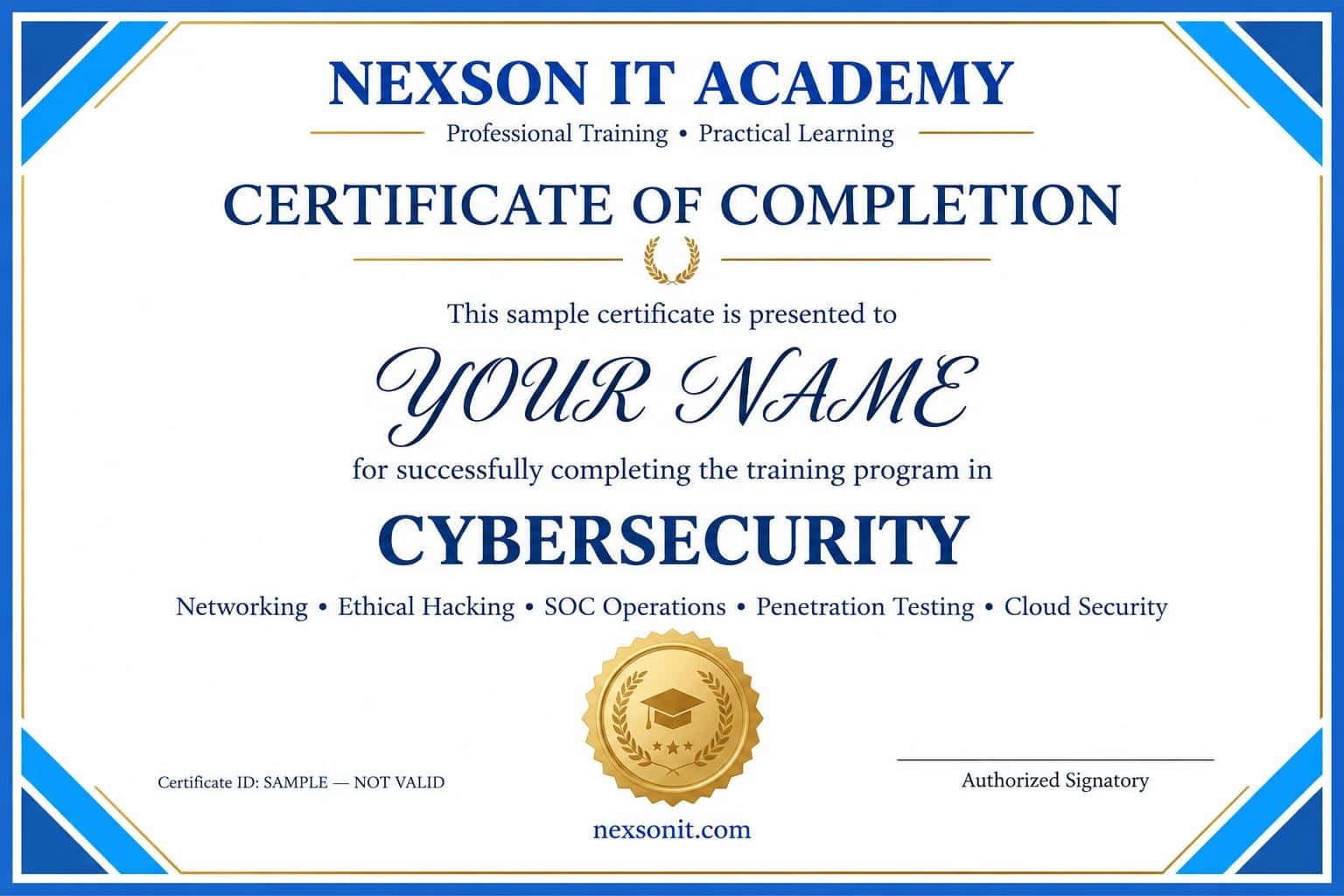
Upon successful completion of the 5-month Cyber Security Master Program, you will receive the official Nexson IT Academy Cybersecurity Master Program Certification. This certification validates your comprehensive training in ethical hacking, penetration testing, SOC operations, cloud security, and incident response.
- Academy-issued course completion certificate
- Validates hands-on practical skills
- Includes project completion verification
- Lifetime certificate validity
Sample Cybersecurity Master Program Certificate
📚 Optional Industry Certifications (Available at Extra Cost)
While our program provides comprehensive training that prepares you for multiple industry certifications, these external certifications are not included in the course fee. If you wish to pursue any of these certifications, we offer preparation guidance and can assist with registration at additional cost.
| Certification | Vendor | Focus Area | Status |
|---|---|---|---|
| CEH (Certified Ethical Hacker) | EC-Council | Ethical Hacking | Extra Cost |
| CompTIA Security+ | CompTIA | Security Fundamentals | Extra Cost |
| CompTIA CySA+ | CompTIA | SOC Operations | Extra Cost |
| AWS Security Specialty | Amazon | Cloud Security | Extra Cost |
| Azure Security Engineer | Microsoft | Azure Security | Extra Cost |
| CISSP | ISC² | Security Management | Extra Cost |
| Splunk Core Certified | Splunk | SIEM | Extra Cost |
| OSCP Foundation | Offensive Security | Penetration Testing | Extra Cost |
💡 Want Industry Certifications?
Contact our career advisor to learn about certification exam fees, preparation packages, and discounted exam vouchers available for Nexson students.
Classroom vs Live Online Cybersecurity Master Training
Nexson IT Academy offers Cybersecurity Master training in Hyderabad with classroom and live online options. Confirm Ameerpet or Kukatpally batch availability before travelling.
| Compare | Classroom | Live online |
|---|---|---|
| Location | ClassroomAmeerpet or Kukatpally, Hyderabad — confirm the course batch | Live onlineJoin from Bangalore or anywhere across India |
| Class format | ClassroomFace-to-face, trainer-led sessions | Live onlineLive, instructor-led sessions |
| Curriculum | ClassroomCybersecurity Master syllabus and guided security exercises | Live onlineThe same core course syllabus |
| Practical learning | ClassroomVirtual labs* and BYOD practical exercises | Live onlineVirtual labs* and BYOD practical exercises |
| Certification | ClassroomNexson IT Academy course completion certificate | Live onlineThe same academy-issued certificate |
| Placement support | Classroom100% Placement Assistance with 6 Months Placement Support | Live online100% Placement Assistance with 6 Months Placement Support |
| Schedule and fees | ClassroomConfirm current batch dates and the full flat course fee | Live onlineConfirm current batch dates and the full flat course fee |
*Confirm Virtual labs access details, covered tools and any applicable conditions with admissions before enrollment. Enterprise tool licenses and vendor exam vouchers are not promised as included. Placement assistance is support, not a job guarantee.
Check campus contact details and directions before visiting.
Why Nexson IT Academy Is the Best Cybersecurity Institute in Hyderabad
When searching for the best cybersecurity institute in Hyderabad, you'll find many options. However, Nexson IT Academy stands out for several compelling reasons. Here's why thousands of students and professionals choose us for their cybersecurity training:
Industry-Expert Trainers
Learn from our team of certified industry professionals with 10+ years of real-world cybersecurity experience in MNCs.
Practical-First Approach
80% of our training is hands-on. Learn by doing, not just watching. Work on real security scenarios and live projects.
Comprehensive Curriculum
Our syllabus covers all major cybersecurity domains – from ethical hacking to cloud security to security leadership.
Strong Placement Record
100% Placement Assistance with average packages of 8-15 LPA. Our alumni work in TCS, Infosys, Wipro, Deloitte, and more.
Prime Location
Located in Ameerpet, Hyderabad's IT training hub. Easy access from KPHB, Hitech City, Madhapur, and SR Nagar.
Lifetime Support
Access to lab resources, course updates, and career support even after course completion. We're invested in your long-term success.
Advantages of Taking a Cyber Security Masters Course in Hyderabad or Online
Enrolling in a Cyber Security Masters Course in Hyderabad at Nexson IT Academy offers numerous advantages that can fast-track your career in the cybersecurity industry. Here's what you gain:
📈 Career Advantages
🎓 Learning Advantages
🌍 Why Hyderabad is the Best Place for Cybersecurity Training
Hyderabad is India's cybersecurity hub with major companies like Microsoft, Amazon, Google, TCS, Infosys having their security teams based here. Training in Hyderabad gives you direct access to networking events, job fairs, and placement opportunities in these organizations. Our Ameerpet location is strategically positioned for easy access to Hitech City and HITEC City security companies.
Cybersecurity Master Program Practical Labs & Projects
Build a practical portfolio through guided security exercises on authorized training targets. Virtual labs* are also provided alongside BYOD practice; confirm covered tools and access details with the advisor.

Network Penetration Test & Report
Document your testing workflow, findings and recommended remediation on an authorized training target.
Web Application Security Assessment
Apply the course tools to a guided scenario and present your work in a clear project report.
Further Portfolio Exercises
- SOC Incident Investigation & Response
- Cloud Security Audit (AWS/Azure)
- Malware Analysis & Reverse Engineering
- Security Policy Development
Cybersecurity Career Path, Job Roles, Salary Range & Career Roadmap
A cybersecurity career offers excellent growth potential, competitive salaries, and job security. Here's a comprehensive breakdown of job roles and salary expectations after completing our Cyber Security Master Program:
| Job Role | Experience Level | Salary Range (India) | Skills Required |
|---|---|---|---|
| SOC Analyst L1 | Fresher - 1 Year | 4-7 LPA | SIEM, Log Analysis, Incident Triage |
| SOC Analyst L2/L3 | 2-4 Years | 8-14 LPA | Threat Hunting, IR, Forensics |
| Penetration Tester | 1-3 Years | 8-18 LPA | Ethical Hacking, Exploitation |
| Security Engineer | 2-4 Years | 10-20 LPA | Security Tools, Automation |
| Cloud Security Engineer | 2-5 Years | 12-22 LPA | AWS/Azure Security, DevSecOps |
| Security Architect | 5+ Years | 18-35 LPA | Security Design, Leadership |
| Security Consultant | 3-6 Years | 15-30 LPA | Risk Assessment, Compliance |
| CISO | 10+ Years | 30-60+ LPA | Leadership, Strategy, Governance |
🗺️ Cybersecurity Career Roadmap
Cybersecurity Job Placement Assistance, Internships & Hiring Support
At Nexson IT Academy, we don't just train you – we help you land your dream cybersecurity job. Our comprehensive placement assistance program is designed to maximize your employability and connect you with top employers:
Resume Building
Professional resume crafting with ATS optimization, highlighting your projects and certifications.
Mock Interviews
Multiple rounds of technical and HR mock interviews with detailed feedback.
Job Referrals
Direct referrals to our 100+ hiring partners including TCS, Infosys, Wipro, Deloitte.
Internship Support
Opportunities for paid internships with our partner companies during the course.
🏢 Our Hiring Partners Include:
Upcoming Cybersecurity Master Program Batches & Schedule
Pick a batch that fits your day. Weekday, weekend and live online options are available.
New batches start every month
Ask our advisor for the next start date and timings.
Cybersecurity Student Success Stories & Testimonials (Hyderabad & Online Learners)
Our students' success is our greatest achievement. Here are some inspiring stories from our cybersecurity training graduates from Hyderabad and across India:
Ravi Kumar
SOC Analyst at TCS
From: KPHB, Hyderabad
"Nexson IT Academy transformed my career. As a fresher with no IT background, I was skeptical. But the hands-on training and placement support helped me land my dream job at TCS within 2 months of completing the course."
Priya Sharma
Penetration Tester at Deloitte
From: Bangalore (Online Student)
"The online live training was as effective as classroom. The trainer's practical approach and real-world scenarios made complex concepts easy. The lab access was exceptional. Highly recommend!"
Mohammed Irfan
Security Engineer at Infosys
From: Madhapur, Hyderabad
"I was a network engineer looking to transition to security. The Cyber Security Master Program gave me comprehensive skills in ethical hacking, SOC, and cloud security. Now I'm a Security Engineer!"
Sneha Reddy
Cloud Security Analyst at Amazon
From: Hitech City, Hyderabad
"The AWS and Azure security modules were game-changers. Combined with the certifications I earned, I landed a role at Amazon. Thank you Nexson IT Academy!"
Cyber Security Master Course Student Reviews and Ratings (Ameerpet, KPHB, India)
4.9/5
Overall Rating
4.8/5
Course Content
4.9/5
Trainer Quality
4.7/5
Placement Support
Best cybersecurity training in Ameerpet! Comprehensive curriculum and excellent practical exposure.
The trainers are amazing. Their industry experience shows in every session. Highly recommended!
Online training was seamless. Got placed at Wipro within 1 month of completion.
Good course content and placement support. Weekend batch timing was very convenient for working professionals.
About Nexson IT Academy – Best Cybersecurity Training Institute in Hyderabad
Nexson IT Academy is Hyderabad's premier IT training institute specializing in cybersecurity, cloud computing, and DevOps training. Located in the heart of Ameerpet – India's IT training capital – we have been transforming careers since our inception.
Our mission is to bridge the cybersecurity skill gap in India by providing world-class, industry-aligned training that prepares students for real-world challenges. We believe in practical learning, industry mentorship, and comprehensive placement support.
With 2,500+ trained professionals, 100% Placement Assistance, and partnerships with 100+ companies, Nexson IT Academy is the trusted choice for cybersecurity training in Hyderabad and across India.
📍 Our Location
#201, 2nd Floor, KVR Enclave, Above Bata Showroom & ICICI Bank, Beside Asian Satyam Mall (AAA Cinemas), Ameerpet, Hyderabad, Telangana 500016
+91 8886662875, +91 8019270281
info@nexsonit.com
Cybersecurity Master Industry Insights & Market Trends 2024-2025
The cybersecurity industry is experiencing unprecedented growth, with India emerging as a major hub for security talent
Expected market size by 2030 with 12.4% CAGR growth rate
Critical talent shortage creating massive opportunities in India
Cybersecurity roles growing 3x faster than overall IT jobs
Experienced cybersecurity masters earn premium packages
Growing threats driving demand for security professionals
Every organization now needs comprehensive security expertise
The cybersecurity master program in Hyderabad prepares you for this explosive growth. As organizations across India undergo digital transformation, the need for advanced security professionals has never been greater. Our master program covers everything from foundational security concepts to advanced threat hunting, cloud security architecture, and security leadership.
Hyderabad has emerged as India's cybersecurity capital, with major security operations centers for global companies located in Hitech City, Madhapur, and Gachibowli. Our cybersecurity master training institute in Ameerpet is strategically positioned to connect students with these opportunities through our extensive industry network.
The master-level cybersecurity professional is uniquely positioned to address the full spectrum of security challenges, from strategic planning to hands-on incident response. This comprehensive skill set commands premium salaries and opens doors to leadership positions in security organizations.
Cybersecurity Master Career Paths & Job Roles
Our comprehensive master program prepares you for the most prestigious and highest-paying roles in cybersecurity
Completing the cybersecurity master program at Nexson IT Academy Hyderabad opens doors to the most prestigious and highest-paying roles in the industry. Our comprehensive curriculum is designed to prepare you for leadership positions that command premium salaries.
The master-level professional is expected to not just execute security tasks but to lead teams, develop strategies, and communicate with executive leadership. Our training emphasizes both technical mastery and the soft skills essential for career advancement.
With the best cybersecurity master training in Ameerpet, you'll develop the expertise to handle the most complex security challenges and lead organizations through their security transformation journeys.
Chief Information Security Officer (CISO)
Lead the entire security strategy and team for an organization, reporting to C-suite executives.
Security Architect
Design and implement comprehensive security architectures for complex enterprise environments.
Threat Intelligence Lead
Lead threat intelligence operations and provide strategic insights to protect organizations from advanced threats.
Senior Penetration Tester
Lead offensive security engagements and identify vulnerabilities in complex enterprise environments.
Cloud Security Architect
Design and implement security for multi-cloud and hybrid cloud environments.
SOC Manager
Manage security operations center teams and oversee 24/7 threat monitoring and response.
Comprehensive Skills Covered in Cybersecurity Master Program
Master 100+ technical and soft skills that make you a complete security leader
The cybersecurity master program in Hyderabad is designed to create complete security leaders. Our curriculum covers over 100 skills across technical, operational, and leadership domains. From advanced exploitation techniques to executive communication, we prepare you for every aspect of security leadership.
What sets our master cybersecurity training in KPHB and Ameerpet apart is the emphasis on real-world application. Every skill is taught with practical exercises, case studies, and projects that simulate actual enterprise environments.
Advanced Ethical Hacking
- Advanced exploitation
- Zero-day research
- APT simulation
- Evasion techniques
- Custom tool development
- Red team operations
Security Architecture
- Enterprise security design
- Zero trust architecture
- Defense in depth
- Security frameworks
- Technology selection
- Integration patterns
Cloud Security Mastery
- AWS security architecture
- Azure security center
- GCP security
- Multi-cloud security
- Container security
- Serverless security
Threat Intelligence
- Threat hunting
- MITRE ATT&CK
- Intelligence gathering
- APT analysis
- IOC development
- Strategic intelligence
Security Operations
- SOC management
- SIEM mastery
- SOAR automation
- Incident command
- Forensics leadership
- Threat detection
Leadership & Strategy
- Security strategy
- Risk management
- Compliance leadership
- Budget planning
- Team development
- Executive communication
Who Should Join the Cybersecurity Master Program
This advanced program is designed for professionals looking to elevate their security careers to leadership positions
The cybersecurity master program at Nexson IT Academy is designed to take professionals from intermediate to expert level. While prior IT experience is helpful, our comprehensive curriculum ensures all students achieve mastery regardless of background.
Many of our successful graduates came from diverse backgrounds including network administration, software development, and even non-IT fields. The key is commitment and passion for cybersecurity.
Required Prerequisites
- Bachelor's degree in any discipline (BTech, BCA, BSc, BCom, BA)
- Basic understanding of IT and networking concepts
- Passion for cybersecurity and continuous learning
- Commitment to 5-6 months of intensive training
Helpful But Not Mandatory
- Prior experience in IT or cybersecurity (1-3 years)
- Basic understanding of Linux and Windows systems
- Familiarity with networking protocols
- Any security certifications (CompTIA, Cisco, etc.)
Not Required
- Programming expertise
- Advanced mathematics
- Prior hacking experience
- Expensive home lab setup
Ideal For
- IT professionals seeking career advancement
- Network administrators moving to security
- Fresh graduates with technical aptitude
- Career changers with passion for security
Best Cybersecurity Master Training Locations in Hyderabad
Looking for the best cybersecurity master training institute in Hyderabad? Nexson IT Academy's master program is available at our flagship center in Ameerpet, the IT training capital of India. Our strategic location provides easy access from all major areas of Hyderabad.
Our cybersecurity master training in Ameerpet offers the perfect environment for intensive learning. With state-of-the-art labs, experienced instructors, and proximity to major IT hubs, we provide an unmatched learning experience.
For professionals in KPHB, Madhapur, Hitech City, and Gachibowli, our Ameerpet center is easily accessible via public transport and major roads. We also offer hybrid learning options for those who prefer flexibility.
Training Locations in Hyderabad
- Main Center: Ameerpet - 2 min from Metro Station
- Easy access from KPHB, Madhapur, Hitech City, Kukatpally
- State-of-the-art training facility with modern labs
Why Cybersecurity Master Program Training in Hyderabad?
- •5-6 month intensive master program
- •Comprehensive training coverage
- •Enterprise-grade lab environment
- •100+ industry tool mastery
- •Leadership and strategy modules
Start Your Cybersecurity Master Program Career in Hyderabad
Join 5000+ students trained in cybersecurity at Nexson IT Academy
Why Choose Nexson IT Academy for Cybersecurity Master Training
Understanding what makes our master program the best choice for aspiring security leaders
The Most Comprehensive Cybersecurity Master Program in India
Nexson IT Academy's Cybersecurity Master Program represents the pinnacle of security education in India. Our 5-6 month intensive course is designed to create complete security leaders who can handle every aspect of enterprise security, from hands-on technical work to strategic leadership.
Unlike basic certification courses that cover only specific domains, our master program provides a holistic view of cybersecurity. We cover ethical hacking, penetration testing, SOC operations, cloud security, DevSecOps, and security leadership in a single comprehensive curriculum.
- Comprehensive training covering 15+ security domains
- 100+ tools and technologies mastered
- Real-world projects simulating enterprise environments
- Leadership and strategy modules for career advancement
- Executive communication and presentation skills
- Mentorship from industry CISOs and security leaders
Industry-Aligned Master Curriculum
Our curriculum is developed in consultation with security leaders from Fortune 500 companies. We continuously update our content to reflect the latest threats, technologies, and industry best practices. This ensures our graduates are prepared for the challenges they'll face in the real world.
The master program covers advanced topics not typically found in basic courses, including APT simulation, threat intelligence operations, cloud security architecture, security automation, and the business aspects of security management.
Expert Faculty with Leadership Experience
Our master program is taught by security professionals with 15+ years of industry experience, including former CISOs, security architects, and red team leaders. They bring real-world insights and case studies that you won't find in textbooks.
Beyond technical instruction, our faculty provides mentorship on career development, helping students navigate the path to security leadership positions.
What You'll Master in Our Cybersecurity Master Program
A deep dive into the advanced topics covered in our comprehensive security training
Advanced Offensive Security
The offensive security module takes your hacking skills to the next level. You'll learn advanced exploitation techniques, zero-day research methodologies, and how to conduct full-scope red team operations that simulate real-world adversaries.
Our advanced ethical hacking training in Hyderabad includes custom tool development, evasion techniques, and the ability to chain multiple vulnerabilities into comprehensive attack paths.
- Advanced exploitation and post-exploitation
- Custom exploit development
- Red team operations and planning
- Evasion and anti-forensics
- Physical security testing
- Social engineering at scale
Security Architecture & Engineering
Learn to design security architectures for complex enterprise environments. This module covers zero trust principles, defense in depth strategies, and the integration of security into every aspect of IT infrastructure.
You'll work on case studies from real enterprises and learn how to evaluate, select, and implement security technologies that align with business objectives.
Cloud Security Leadership
As organizations migrate to the cloud, security professionals with cloud expertise are in high demand. Our master program covers security architecture for AWS, Azure, and GCP, including multi-cloud and hybrid environments.
You'll learn to implement security automation, container security, serverless security, and cloud-native security operations.
Security Strategy & Leadership
The final phase of our master program focuses on the skills needed to lead security organizations. You'll learn security strategy development, risk management frameworks, compliance leadership, and how to communicate security to executive audiences.
This module includes simulations of board presentations, budget planning exercises, and team management scenarios.
Student Journey at Nexson IT Academy
Your Journey from Enquiry to Training, Skill Development & Career Preparation
At Nexson IT Academy, we guide students through every stage of their learning journey. From selecting the right course and attending expert-led training to gaining practical experience and preparing for job opportunities, we provide structured learning resources and career support to help students move forward with confidence.
- 1Enquiry & Admission
- 2Student Onboarding & Portal Access
- 3Training & Practical Skill Development
- 4Career Preparation & Job Assistance
- 5Course Completion & Certification
1Phase 1: Enquiry & Admission
- Step 1
Course Enquiry
Get in touch with Nexson IT Academy to learn about available courses and find a suitable training program.
- Step 2
Course Counselling
Understand course details, duration, training methodology, and fee structure. Get answers before you decide.
- Step 3
Course Syllabus & Content Sharing
Review the syllabus, topics covered, and course information to understand what you will learn.
- Step 4
Attend a Demo Class
Experience a demo session with the trainer, understand the teaching approach, and clarify your doubts.
- Step 5
Fee Payment & Admission Confirmation
Once satisfied with the course and demo, complete the fee payment and confirm your admission.
2Phase 2: Student Onboarding & Portal Access
- Step 6
Student Registration
Complete the registration process and provide the required details to begin your learning journey.
- Step 7
Batch Schedule & Training Details
Receive information about your batch timings, training schedule, and course commencement.
- Step 8
Course Portal Access
Access recorded training videos and learning materials to revise concepts at your own pace.
- Step 9
Task Portal Access
View assignments, complete practice exercises, and manage regular training activities.
3Phase 3: Training & Practical Skill Development
- Step 10
Expert-Led Training
Attend structured sessions and learn technical concepts through guided instruction from experienced trainers.
- Step 11
Practical Lab Access
Where applicable, access hands-on labs to practice relevant tools, technologies, and exercises.
- Step 12
Assignments & Practical Exercises
Apply your knowledge through assignments, practical exercises, and course-related projects.
- Step 13
Exam Portal & Knowledge Assessment
Practice mock tests and take assessments to identify knowledge gaps and improve preparation.
4Phase 4: Career Preparation & Job Assistance
- Step 14
Professional Resume Preparation
Create a professional resume that highlights your technical skills, projects, training, and experience.
- Step 15
LinkedIn Profile Optimization
Improve your LinkedIn profile to showcase your skills and strengthen visibility to recruiters.
- Step 16
Technical & HR Mock Interviews
Practice technical and HR questions, improve communication, and build interview confidence.
- Step 17
Job Portal Access & Latest Job Updates
Access job portal resources and receive relevant job updates to support your job search.
5Phase 5: Course Completion & Certification
- Step 18
Course Completion Certificate
Receive your course completion certificate after fulfilling the applicable completion and assessment requirements.
Your learning journey is designed to help you build knowledge, develop practical skills, and prepare for career opportunities with confidence.
Cybersecurity Master Program FAQs
Expert answers to common questions about our comprehensive master program
Fast Answers
- What is the Cybersecurity Master Program?
- Our Cybersecurity Master Program is a comprehensive 5–6 month training that covers all major security domains including ethical hacking, SOC operations, cloud security, and security leadership.
- What is the fee for the Cybersecurity Master Program?
- The course fee is ₹1,00,000 with flat pricing.
- What is the duration of the master program?
- The Cybersecurity Master Program is a 5-6 month intensive course covering comprehensive training.
- What job roles can I get after the master program?
- Graduates typically secure roles like Security Architect, SOC Manager, Senior Penetration Tester, Cloud Security Lead, and progress toward CISO positions.
Still have questions? Contact Nexson IT Academy at +91 8886662875 or WhatsApp us for answers. Our training advisors are available 7 AM – 9 PM, 7 days a week.
Cybersecurity Master Program Brochure & Syllabus
Request the course syllabus, current batch details and enrollment information from our training advisor.
Contact Your Cybersecurity Master Program Training Advisor
Email Us
info@nexsonit.comVisit Us
#201, 2nd Floor, KVR Enclave, Above Bata Showroom, Ameerpet, Hyderabad - 500016